In Flanders Fields
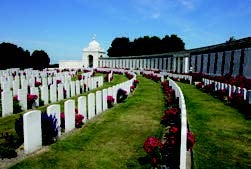
In Flanders Fields, the poppies blowBetween the crosses, row on row,That mark our place; and in the skyThe larks, still bravely singing, flyScarce heard amid the guns below.We are the dead. Short days agoWe lived, felt dawn, saw sunset glow,Loved and were loved, and now we lie,In Flanders fields.Take up our quarrel with the foe:To you from failing hands we throwThe torch; be yours to hold it high.If ye break faith with us who dieWe shall not sleep, though poppies growIn Flanders fields.
In Flanders Fields" is a war poem in the form of a rondeau, written during the First World War by Canadian physician Lieutenant-Colonel John McCrae. He was inspired to write it on May 3, 1915, after presiding over the funeral of a friend and fellow soldier, Lieutenant Alexis Helmer. They died in the Second Battle of Ypres. According to legend, fellow soldiers retrieved the poem after McCrae, initially dissatisfied with his work, discarded it. "In Flanders Fields" was first published on December 8 of that year in the London magazine Punch. Flanders Fields is a common English name for the World War I battlefields in Belgium and France.
It is one of the most quoted poems from the war. As a result of its immediate popularity, parts of the poem were used in efforts and appeals to recruit soldiers and raise money selling war bonds. In addition, it references the red poppies that grew over the graves of fallen soldiers, resulting in the remembrance poppy becoming one of the world's most recognized memorial symbols for soldiers who have died in the conflict. The poem and poppy are prominent Remembrance Day symbols throughout the Commonwealth of Nations, particularly in Canada, where "In Flanders Fields" is one of the nation's best-known literary works. The poem is also widely known in the United States and is associated with Veterans Day and Memorial Day.